
I have been digging into the back story on a popular fiber arts product that went VIRAL after being on Shark Tank. I have been exploring this recent phenomenon and started with their origin story.
According to available public information, the founders left high-profile jobs (one at Google UX and the other at Deutsche Bank/Wall Street) because they were unfulfilled in their jobs. They apparently had enough money to afford time to explore what kind of a business they could start (without the bother of also holding down full-time jobs) and landed on crochet kits because one of them had begun crocheting as a way to cope with stress and rebuild confidence after struggling in their management role. According to the article I read, they found learning to crochet difficult and wanted a simpler way to make their first project: a small, amigurumi penguin.
I highlight this for a couple reasons. First, as an educator, I support any and all efforts to provide avenues for learning. I also support individuals as entrepreneurs who identify good ideas and build out that concept as their business. My initial curiosity around this particular business began when I was working a part-time side-hustle at Joann’s, who carried this brand.
This product was never eligible for coupons and never went on sale unless it was being clearance’d out – which was rare. It was also priced significantly higher than most kits in Joann stores at the time. Initially I felt that the educational angle likely justified the cost, which was around $30 (US) for a kit to make a single, small amigurumi critter, with “small” representing things that were about the size of a tennis ball. I also recognize that we all learn differently and felt that the video tutorials were a great idea for younger generations to use as a guide.
The product launched during COVID where a lot of us were returning to our fiber arts roots as we spent a lot more time at home. We also saw a lot of NEW fiber artists picking up crocheting, knitting, quilting and sewing. These hobbies were no longer reserved for grandmothers, and that was a benefit for ALL fiber artists!
Because I was not a new crocheter, and never saw a pattern in the offerings that compelled me to spend $30 to make it, I never bought one, but I have continued to watch their evolution.
Recently, I stumbled onto their website which is what inspired me to write this post. The offerings have grown, and what were once basic egg-shaped figures with add-ons like ears, arms, noses, eyes, and other similar features, have now expanded to be a collection of egg-shaped figures in a single set. The PRICE POINTS on these collections range from $100 to $210.
The $210 kit made me spit out the coffee I was drinking, which inspired me to look deeper into the company’s mission and vision.
IF the original mission was to help people learn how to crochet, and to prove to themselves that they can do something new, why do these things continue to be over-priced, crocheted eggs kits with decorative features? During their appearance on Shark Tank, they pitched themselves not as a craft company, but as an education company that teaches beginners a new skill through approachable characters and step‑by‑step videos.
Sadly, I see no “growth” in the product specific to providing anything close to an education on crocheting. Instead, it seems that there are just continuous iterations of decorations added to the basic egg shape.

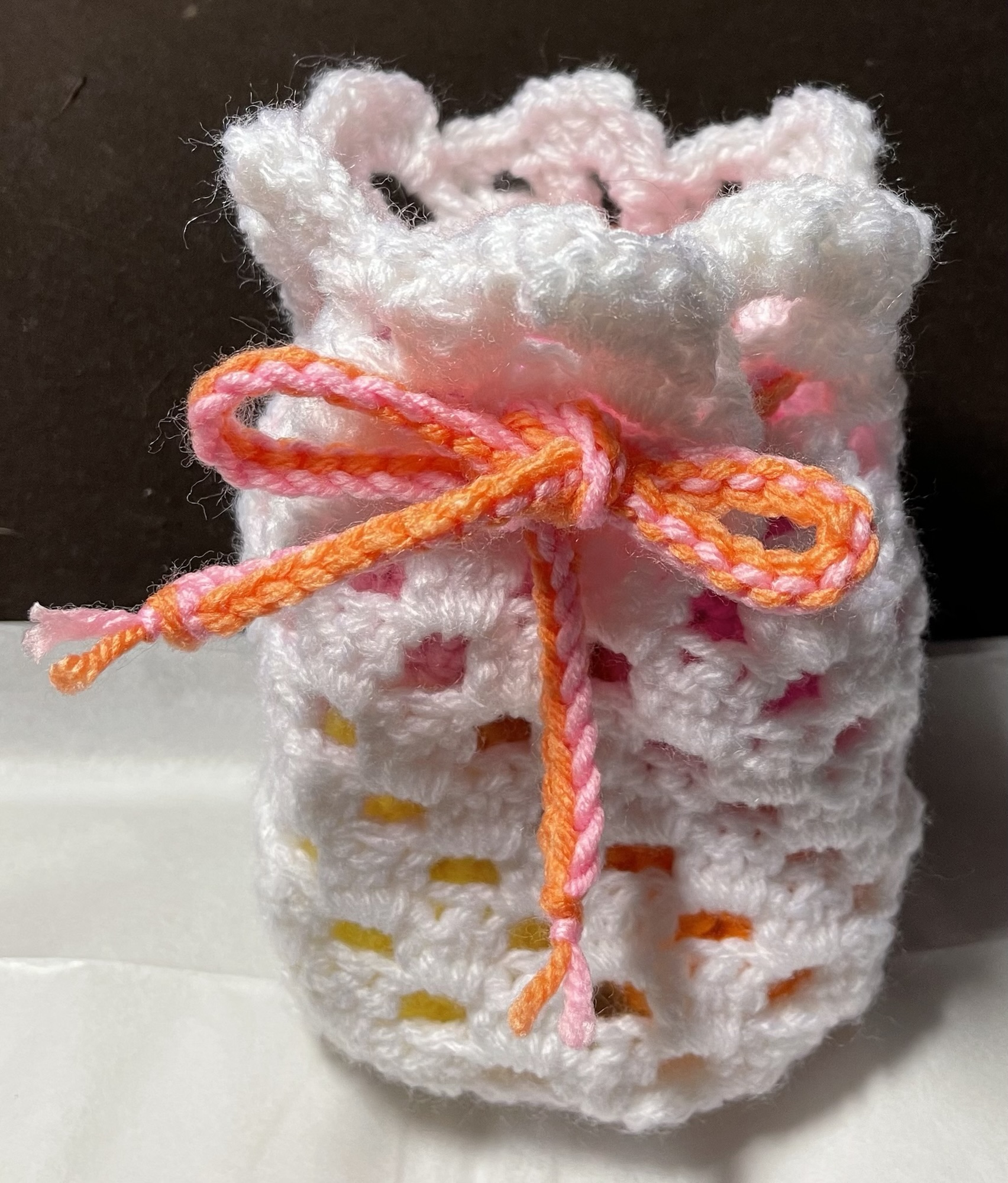
in-progress basket


While I have also crocheted simple eggs, such as the ones pictured above for my then-youngest granddaughter at Easter, crocheting is much more than just amigurumi. The value-add (for me) in continuing to pay for instruction on how to crochet yet another egg with accessories seems to trigger the Law of Diminishing Returns.
- The law of diminishing marginal returns indicates that continuously adding more of one type of input, while keeping all other inputs constant, eventually leads to a decrease in the efficiency of additional input use.
I admit that I may be more jaded than I should be about this. The founders’ Silicon Valley/Wall Street origin stories give me big time Private Equity (PE) vibes, and we all know how good PE has been to the crafting world (that was sarcasm, in case you couldn’t hear it in my voice).
- I’ve shared links at the bottom of this post to 2 previous blogs about Private Equity and the damage it continues to do to the fiber arts community at large.
If the GOAL was indeed to TEACH people how to crochet so that they can learn how to “prove to themselves that they can do something new“, why not expand beyond the fancy egg shapes?
The answer that I see to this question is that this was never about a love for crochet, or an interest in teaching people anything about themselves. This was a case of people finding a niche market (made obvious during COVID), having enough money to put in the time (not having to work while also building the business), and the resources to launch a company where they found success, and are hoping they can simply “rinse and repeat” for as long as possible.
- “Rinse and repeat” is business shorthand for finding something that works, documenting it, repeating it consistently, and then scaling it.
For those who enjoy these kits, and have the money to spend on repeat purchases, feel free to ignore this post. In my opinion for the same money, a lot of other, more accessible options are available which range from FREE to not even close to the costs of these egg characters in costume.
As I have noted in other posts: I have no beef with a person who comes up with an idea that catches fire, takes off and makes them a lot of money. I cannot and will not take issue with the way this company has elevated crocheting and expanded the demographics to include people of all ages. That alone is a worthy accomplishment.
I do wish, however, that the big talk about being an EDUCATION company had some evidence behind it. Education is a bigger topic than teaching people how to use the item they just purchased. If it’s narrow in scope and specific to the task at hand, it’s just-in-time training; not education.
I also am curious if the founder that struggled to learn how to crochet was doing so because they wanted to learn how to crochet, or if they were doing so to test a market idea. Given the stall in creativity around the crocheting aspect of the product, I suspect it was the latter.
It will be interesting to see how long Gen Z (the biggest driver of their success) will continue to be an economic force for this product. As a group, they’re not big on continuing to feed the big money corners of society, and they’re also much more pragmatic than older shoppers about reusing things – like patterns and techniques that they’ve learned.
Don’t take it from me though; see how Gen Z’s opinion on organized religion is working out for churches hoping to grow (hint: it isn’t).
Given these issues, plus the general state of the economy, I am curious how long their initial success will be sustained.
Only time will tell.
(C) 2026 Stitch ‘n Dish
Related blog posts:
- The end goals (private equity in the fiber space)
- The Joann (ending) story (how private equity killed Joann stores)