
I learned to sew on a Kenmore sewing machine, which I was using up until about 10 years ago when I purchased a Singer model at Joann’s. About a year ago I was offered a great deal on a used Brother sewing machine that had a (basic) embroidery option, which is why I bought it. I thought it would be a good option for learning about machine embroidery.
While sewing seems pretty straightforward, each machine has its particulars. I got the Brother for $50, and it came threaded, with two full bobbins on reserve, all of the parts and accessories, including the instruction manual. I was able to sit down and play with some basic designs in the embroidery module, but hadn’t made friends with it for sewing. I had sewed a few seams as a “test drive” but never attempted to wind a bobbin or load the thread cartridge, which is a bit different from my other machines.
I’ve been trying to break some bad “after work habits“, so a couple days ago I decided to further explore using my Brother machine. I changed out the embroidery module for the straight sewing module and found some scrap fabric. I was still using the preloaded thread and bobbin, but my goal that evening was simply to become familiar with the settings so I stitched a few test runs.
I knew I wasn’t going to get very far if I continued to use only the pre-loaded thread and bobbin, so the next evening, I removed the bobbin and thread, and started from scratch. I got out the instruction manual, read through winding a bobbin and loading the thread cartridge.
Winding the bobbin was straightforward and worked as outlined in the instruction manual. Inserting a spool of thread into the cartridge, not so much.
It seemed straightforward and simple, but my experience with the Singer and Kenmore machines tripped me up. My first four attempts on a practice seam ended with a nest of thread underneath the fabric. I was unsure whether it was bobbin thread or spool thread, so I changed out the color of the bobbin thread so I could see which one was knotting. It was the spool thread, or as noted in the manual, the “top thread“. I went back to the instruction manual and made sure to pay attention to each and every detail in them, and discovered my error.
I had made an “assumption” about the threading process at the very end (leaving a tail so the thread could be grabbed) because that was a factor on my other machines. Once I disposed of that assumption, and followed the instructions to a “T“, I was off and running.
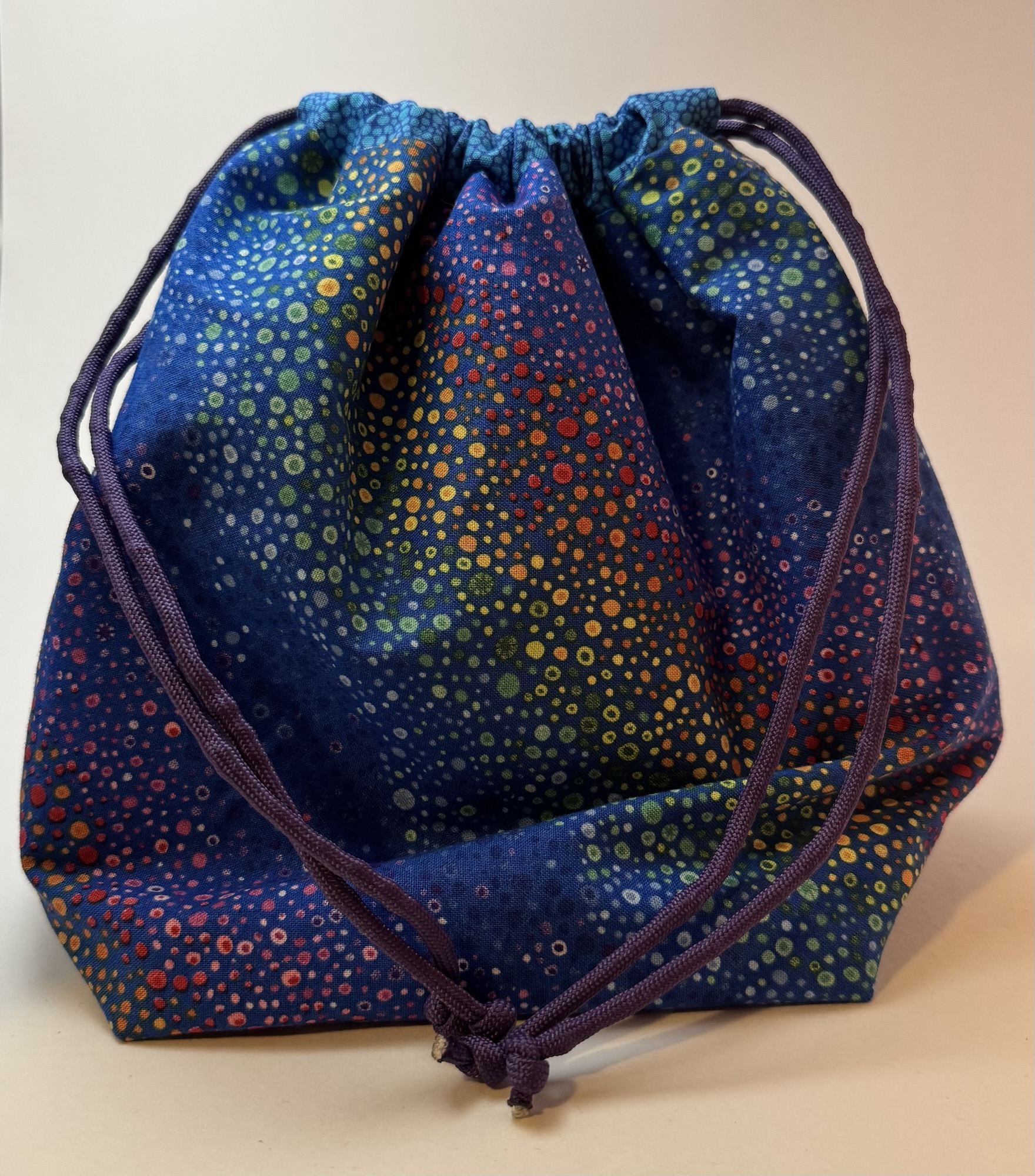
I decided to start with something small so that I could get a feel for this new (to me) sewing machine and found two appropriate pieces of fabric in my remnant stash which would work perfectly for making a simple drawstring bag.


I found the pattern pieces, but could not locate the written pattern, so proceeded by memory since I’ve made a LOT of these over the years. That worked fairly well, but (full disclosure), I did end up having to rip out basting twice, due to me placing pieces in the wrong direction.
The realization
As I finished threading the drawstring cord through the top and setting up my light box (for photographs), I felt a deep sense of satisfaction. I had learned how to work a machine I was unfamiliar with, was able to troubleshoot an issue in somewhat “unfamiliar territory“, and make a small piece, start to finish, by memory.
It would have been easy to walk away when the knots stopped my progress the 4th time, or when I basted bag pieces together incorrectly – again. I didn’t though, because I was certain that I could figure it out,… and I did.
In today’s modern world, we have a lot of options to try and make ourselves feel better, and can spend a lot of money chasing that feeling of satisfaction or contentment, as I have noted in posts on retail manipulation and mindful shopping.
My experience reminded me that there are few better ways to feel those things than to overcome some challenge with our own effort, stubborn determination, and brain power. We know from research in a number of areas, including psychology, that accomplishing even small tasks will trigger a release of dopamine in our brain, which gives us a boost in our mood, fresh motivation, and mental clarity.
I could have shopped after work, or doom-scrolled on my phone while the TV played in the background, but I knew that I’d feel WORSE afterward. Choosing to take on an “unknown” task (would I be able to figure out how to use the Brother machine?), and sticking with it when things didn’t unfold in a straight line gave me psychological benefits and no regrets.
Unlike mindless shopping or wasting time doom-scrolling, that sense of accomplishment has no downsides, and it ages well, meaning that it does not degrade or lose its benefit over time.
It is now well-documented that engaging in fiber arts is good for our mental health and well-being. The knowledge around accomplishing things adds a next level benefit to these activities. I am encouraged to continue taking on things that I am likely to bumble through like a rookie. Not only will I learn new things, but I will boost my self-confidence, sense of self-worth, and overall sense of well-being.
It looks like that $50 investment is already worth a lot more!


(C) 2026 Stitch ‘n Dish
One response to “The benefits of struggle”
[…] my learning journey with my Brother machine last week, and this daring (for me!) exercise in sewing without a pattern, my resolve to do even […]