
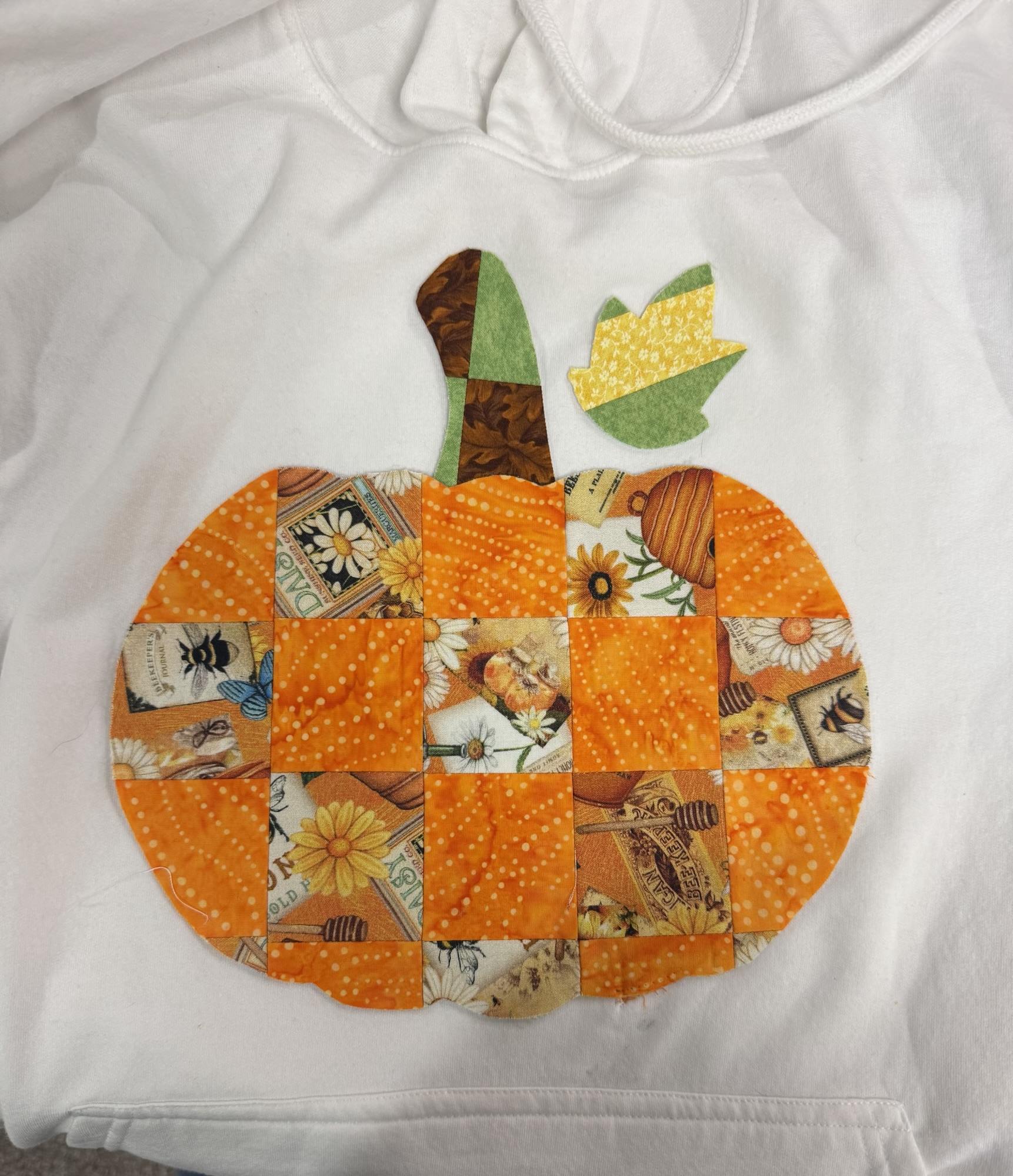
My sister and I attended our 2nd Quilting Retreat this past weekend. We found it to be as enjoyable and fun as our 1st one, back in March.
This time we decided to focus on smaller, non-blanket projects, including a couple options for clothing. I chose to do a harvest pumpkin sweatshirt (pictured mid-project at the top of this post). She settled on doing a happy ghost. She also worked on some quilt squares for a Halloween wall hanging. I worked on a kit for a “raggy bag” I had purchased the year before at a local quilt shop.
We both made a couple mug mats with some holiday flair, as well. (pattern for the mug mats is FREE and from Crafty Staci).
We were lucky to once again sit at a table with 2 other lovely people and that truly doubled the fun.


A potential disaster
On the second day, as I was making great progress, I ran into an unexpected snag. I had started to outline my pumpkin using the blanket stitch but missed some “early warning signs”. I ended up with a nest of top thread under the metal plate. It was so much of a mess that it dislodged the bobbin!
Once I cleared out the blob of thread, my sister (an engineer) came over to see if she could help. Under her breath she quietly said “take a picture of this and see what Claude says”.
We had identified a horizontal bar with a sharp edge that seemed to be the culprit. This was my new (to me) Brother machine and neither one of us were that familiar with its inner workings. The bar didn’t seem interested in moving in any direction, and we didn’t want to force it and break something.
I had brought my Singer machine, and was headed to my car to retrieve it when Claude diagnosed the issue. Both of us hit our heads, Homer Simpson style, when we saw what Claude suggested. Turn off the machine, unplug it for a couple minutes. Then, plug it back in, turn it on and it should reset.
Once we did that, everything was as it should be, and I was able to continue my task. The solution was so simple, and we both laughed at ourselves. If this had been a laptop, iPad or cell phone – we’d have done that first. I guess we’re old enough that we think of sewing machines as more mechanical than digital.
Lesson learned!
I am also fairly certain that using a piece of non-fusible interfacing on the back would have prevented some of the tangling.
Anti-AI sentiments
I cannot tell this story without addressing the issue of AI in the context of the fiber arts community. Many fiber artists get angry anytime Artificial Intelligence (AI) is mentioned, so we don’t talk about it in public. As I have written about in at least one other post, the vitriol and intolerance for AI is widespread. In some corners, it’s considered sacrilegious to use AI in ANY context relative to fiber arts.
This stance fails to see how useful it can be in many ways that do not interfere with artistic creativity. In this instance, an AI tool helped us quickly resolve an issue that had stopped progress. We were both able to get back to the activities of the retreat – fiber arts activities. It ALSO taught us about an inner component that we were unfamiliar with prior to that.
It rarely serves any of us to dig in on a position, refusing to consider any other perspective. I agree that using AI to write patterns, or generate images of artistic creations is awful. But that doesn’t mean that AI is terrible in any format and all contexts. Critical thinking skills allow us to hold conflicting, but nuanced ideas in our minds at the same time. It affords us the ability to see multiple angles of situations, such as this one.
Still, we weren’t at the quilting retreat to argue with anyone. We had a problem, and used a tool we have in our arsenals to solve it. That tool enabled us to return to what we were there to do: quilt.
Planning ahead
We enjoyed this retreat immensely, and continue to be grateful that The Quilting Needle in Glenshaw, PA works hard to bring these to their customers twice a year. Thanks to Rhonda, Katie and the entire TQN team for another terrific retreat!
My sister and I have already penciled in the March date and are discussing project plans. In the meantime, we have some wonderful holiday ideas to work on. Many of these came from chatting with the other attendees, which is another benefit of quilting at a retreat instead of in isolation.
Like knitting and crocheting, quilting offers a number of health benefits – especially at a retreat! Most of us were at least age 55 and many were beyond that, with a decent number being well beyond that. Socialization is SO VERY IMPORTANT to us as we age. These events make it easy to get out, make connections, and engage with others who share our love of quilting.
As we reflect back on our 2-days of quilting, both my sister and I feel that it was even better than the 1st retreat we attended. This was likely a combination of being more familiar with the retreat rhythms, and feeling more comfortable. I know that we both engaged with other attendees more this time, and meeting and making new friends is always a positive outcome.
The tool tally
In addition to using Claude (AI) to solve a pressing issue, we learned about using rosebud protectors to “tame” spools of thread and bobbins. We were introduced to a sewing “glue” that helps with tiny seam allowances, and snipping shears that make tasks such as I will do when finishing my “raggy bag” much simpler. We also traded information about other local shops, and learned about additional venues for quilting getaways.

Most of all, we learned that in a world that seems to be so divided and angry, a room full of women from many different backgrounds, neighborhoods, perspectives, and more came together and had 2 full days of fiber fun. And there’s a larger lesson hiding in plain sight there, if we’re willing to see it.
(C) 2026 Stitch ‘n Dish