
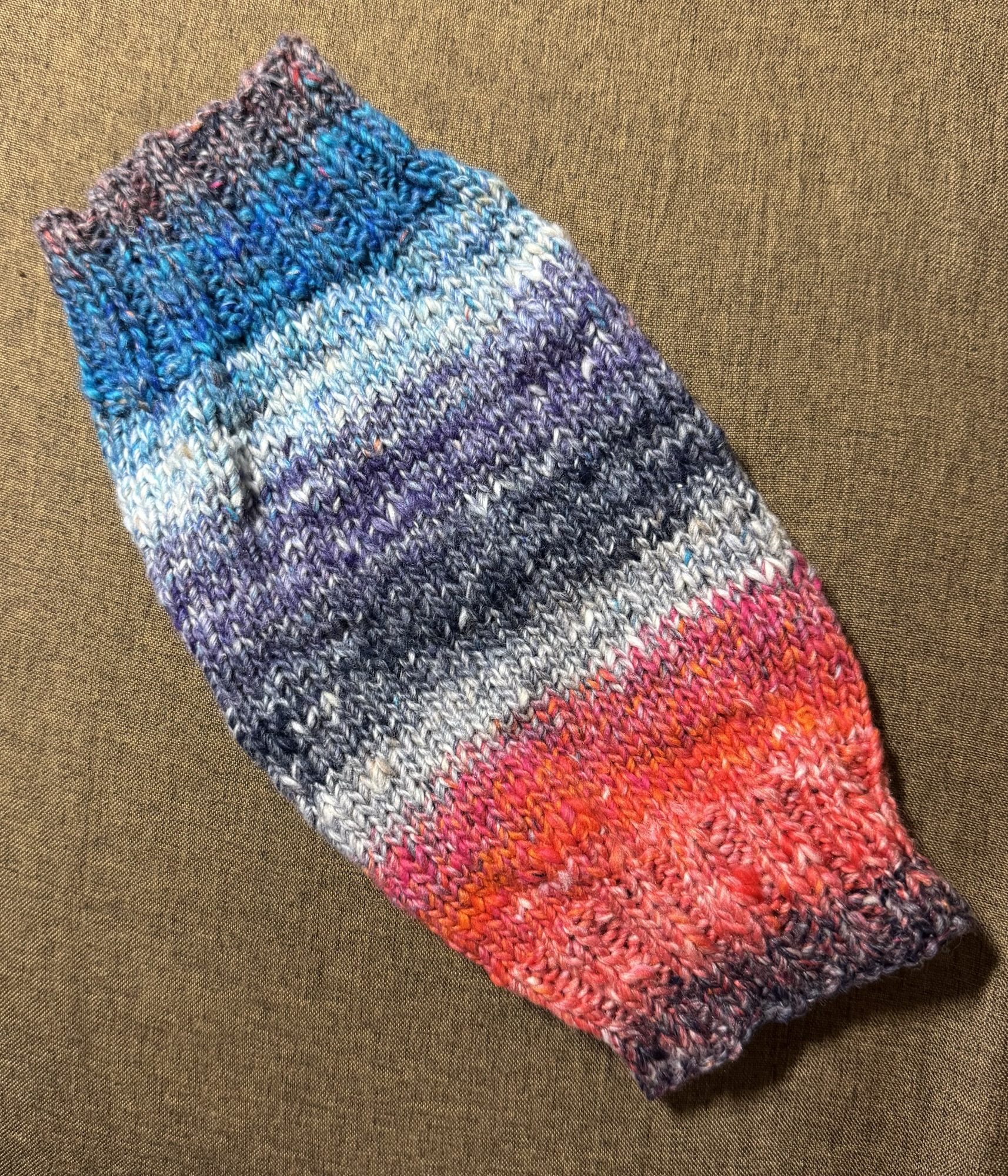
Adhering to my commitment to “shop my stash, FIRST” when beginning a new project, and having still been struggling with wanting to crochet, I had started this mini project for Fall: knitting an abbreviated leg warmer, or as I am calling it, an “ankle warmer“.
I have 3 big Noro balls of yarn (the $50+ ones) – all different colorways, and have never been inspired to make something with any of them. When I got the idea to make some ankle warmers for Fall, I thought this would be a great yarn to use. I’m not sure I would buy this again, however because I have experienced breaks – as I knit (and I’m not a tight knitter) – at least 3 times in the first item, requiring me to tie the active yarn piece back onto the ball. The yarn is lovely, and feels great, but the breaks were disappointing.
After trying this finished ankle warmer on and before starting its mate, I found that the stockinette stitch is less than ideal for a SHORTER leg warmer and am considering doing my NEXT pair in garter stitch, as it is much more “squishy” and I think the “scrunch” on a short piece would be more to my liking.
The PLUSSES on this experiment include what I learned about “winging it” with a pattern intended for a different end result, continued use of dpns (which I think is a great skill to maintain, for a couple reasons), and the overall benefits attributed to spending time engaging in fiber arts.


I have ALSO thought, again, about the way we are all marketed to and manipulated by people selling things. Back in 2024 I wrote about ChiaoGoo needles and questioned their value proposition after an interesting “encounter” on Reddit where I commented on a ChiaoGoo thread and got a lot of pushback.
We all choose to spend or not spend as it meets our needs and wishes, and generally, I support creative people who design something and put it out on the market for people to try and either adopt with enthusiasm or pass on it. The world would be a terribly dull place if these new products never came out and creativity and innovation were stifled. I am NOT suggesting that this is what needs to happen.
I am suggesting that we, as consumers, have been trained like Pavlov’s dog to respond to certain cues, and that sometimes these cues lead us to value things that may not live up to the hype.
Research shows that advertising and marketing manipulate consumers by exploiting cognitive biases, obscuring information, and using deceptive or emotionally charged tactics to get us to BUY NOW! The proliferation of the internet and related digital technologies have made these strategies more powerful, personalized, as well as harder for us to detect.
This is true across industries, and the fiber arts and crafting communities are no exception. The rise of “designer” knitting needles and crochet hooks is a textbook example of luxury‑brand marketing, where companies manufacture perceived value without necessarily delivering proportional functional benefits.
Over the last decade, especially, we have seen an explosion of boutique yarn dyers, artisan tool makers, influencer‑driven product launches, and “collectible” craft accessories. All of this mirrors trends in cosmetics and other areas: everyday tools being reframed as identity objects, instead of functional equipment.
This pattern is strengthened by social media personalities, with audiences large and small, who make money with videos that feature “what’s in my project bag?”, or unboxing content and of course, affiliate links. These things can push makers toward visually distinctive, expensive tools that photograph well, whether or not they perform better.
I have started to remind myself of these tactics when I see a video and start to go “Oooooooh!“, which for me is a signal that my defenses are down.
Let’s look at some of the techniques used to get us to SPEND-SPEND-SPEND and buy-buy-buy.
Marketing techniques that are used to manipulate fiber‑arts consumers include:
- Scarcity and exclusivity
- we see terms like “Limited edition”, “hand‑turned”, “artisan”, “small batch” and “collectible” – all classic scarcity tactic words and phrases.
- Scarcity increases perceived value even when functional value is unchanged.
- Authority bias via influencers
- We all need to remember that influencers often receive free tools or affiliate commissions.
- Their praise creates a false consensus that certain brands are “must‑haves”, but we need to remember that these influencers are PAID for LIKES, CLICKS, and EYES on their videos, as well as a portion of the sales.
- unlike a store that wants someone to come back and purchase more goods, the influencer has very different incentives.
- Emotional positioning
- Tools are increasingly branded as being:
- self‑care
- heirlooms
- investments
- expressions of creativity
- This shifts the conversation away from performance metrics and toward identity and emotion.
- Tools are increasingly branded as being:
- Aesthetic manipulation
- As consumers, we are tempted by tools that have beautiful wood grains, resin swirls, rainbow anodizing, and ornate handles
- all of which create the illusion of craftsmanship
- We need to remember, however; aesthetics ≠ ergonomics.
- As consumers, we are tempted by tools that have beautiful wood grains, resin swirls, rainbow anodizing, and ornate handles
- Price anchoring
- This happens when a company releases a limited edition $150 hook.
- All of a sudden, that $40 hook feels “reasonable“.
- We know from research around consumer psychology that anchoring is one of the most powerful manipulation tactics.
- This happens when a company releases a limited edition $150 hook.
No research exists that shows expensive hooks or needles improve speed, tension, ergonomics, or stitch quality. ALSO, no one can tell which tools are used when they look at a finished product.
- I have this same beef with expensive makeup, and wrote about mascara, specifically, in this blog post.
The things that truly matter for performance include hook head shape, throat depth, handle diameter, weight distribution, material friction, and the user’s hand anatomy.
Guess what? None of these correlate reliably with price.
Expensive tools DO offer some things, and we should also acknowledge those. These include aesthetic appeal, collectible value, brand prestige, influencer validation, and emotional satisfaction.
They do NOT reliably offer reduced hand strain, faster stitching, better stitch consistency, longer lifespan, or even superior engineering. In fact, if you follow along on any of the social media outlets where people vent, you’ll learn how many of the expensive hooks end up cracking, warping, snagging the yarn, with inconsistent sizing, with poorly shaped heads and are heavier which means the are actually worse for ergonomic considerations! From a strictly functional perspective, a $12 Clover Amour or a $10 Susan Bates Silvalume has the ability to outperform a $120 hand‑turned resin hook.
When it comes to the designer knitting needles, the customer complaints and lived experiences include reports that they often loosen at joins (interchangeables), have inconsistent tips, bend under tension, and some even have coatings wear off after little use.
Research on consumer manipulation explains the “why” of continued designer purchasing in the craft and fiber arts space, including:
- Identity signaling
- The belief that owning luxury craft tools signals seriousness, good taste, belonging, and perhaps even status within the community.
- Emotional reward
- Let’s face it: buying a beautiful tool feels good. Feeling good is a valid reasons, but it’s not the same things as functional value.
- Community pressure
- When everyone in a crochet group raves about Furls, Lykke, or ChiaoGoo needles, it creates a social proof loop.
- A social proof loop is when we assume something is correct, valuable, or high‑quality if many people appear to believe it.
- When everyone in a crochet group raves about Furls, Lykke, or ChiaoGoo needles, it creates a social proof loop.
- Sunk‑cost rationalization
- Once we spend $100 on a hook, we’re motivated to believe it’s superior, even if it isn’t.
Now, I want to stop here and point out that while I have questioned the value-add of the ChiaoGoo interchangeable knitting needles, 3rd party evaluators have attested to the engineering that makes them a superior tool in terms of their construction. This is the only “designer” brand fiber arts tool that I saw this kind of commentary on, but felt it was important to point this out.
The bottom line
If we WANT expensive tools, have the resources to purchase them, and like using them – we should keep doing what we’re doing!
However, if we cannot afford them, OR can, but have other things that we need to spend our money on, we should absolutely NOT be influenced into purchasing these, and believing that we will be a better, stronger, faster crocheter or knitter.
(IYKYK)
Like the example in my blog post about mascara, as well as this post about interchangeable needles, no one is going to stop us on the street and comment – positively or negatively – about a piece we’ve made due to the tools we used to make it.
I have pieces that were made with inherited aluminum straight knitting needles and pieces made with expensive interchangeable needles. There is NO DIFFERENCE in the look of the finished pieces. Stockinette stitch is stockinette stitch, garter stitch is garter stitch, and cables are cables.
I have blankets made with the aluminum Boye crochet hooks and blankets made with Furls crochet hooks. There is ZERO difference in the finished pieces.
In a world where businesses are vying for more and more of our hard-earned money while the COST of everything is going UP, and the job market looks increasingly grim; it’s a good time to get our heads in the right place about what is WORTH spending our money on, and what is an optional decision with little to no impact on the end results we are seeking.
In the same way that I have been resisting the urge to shop for entertainment, I am also actively pushing back on things that are marketed as superior, with only a price tag to match the hype.
Let’s embrace technology when it makes sense to, but not lose sight of the heart and soul of our fiber arts practices and traditions by being manipulated into spending money on the latest fads.
(C) 2026 Stitch ‘n Dish